How a powerful document did what it was supposed to do.
There are dozens of declarations that we could look at more closely, but today, I’d love discuss the document-power that is carried inside the Declaration of Independence.
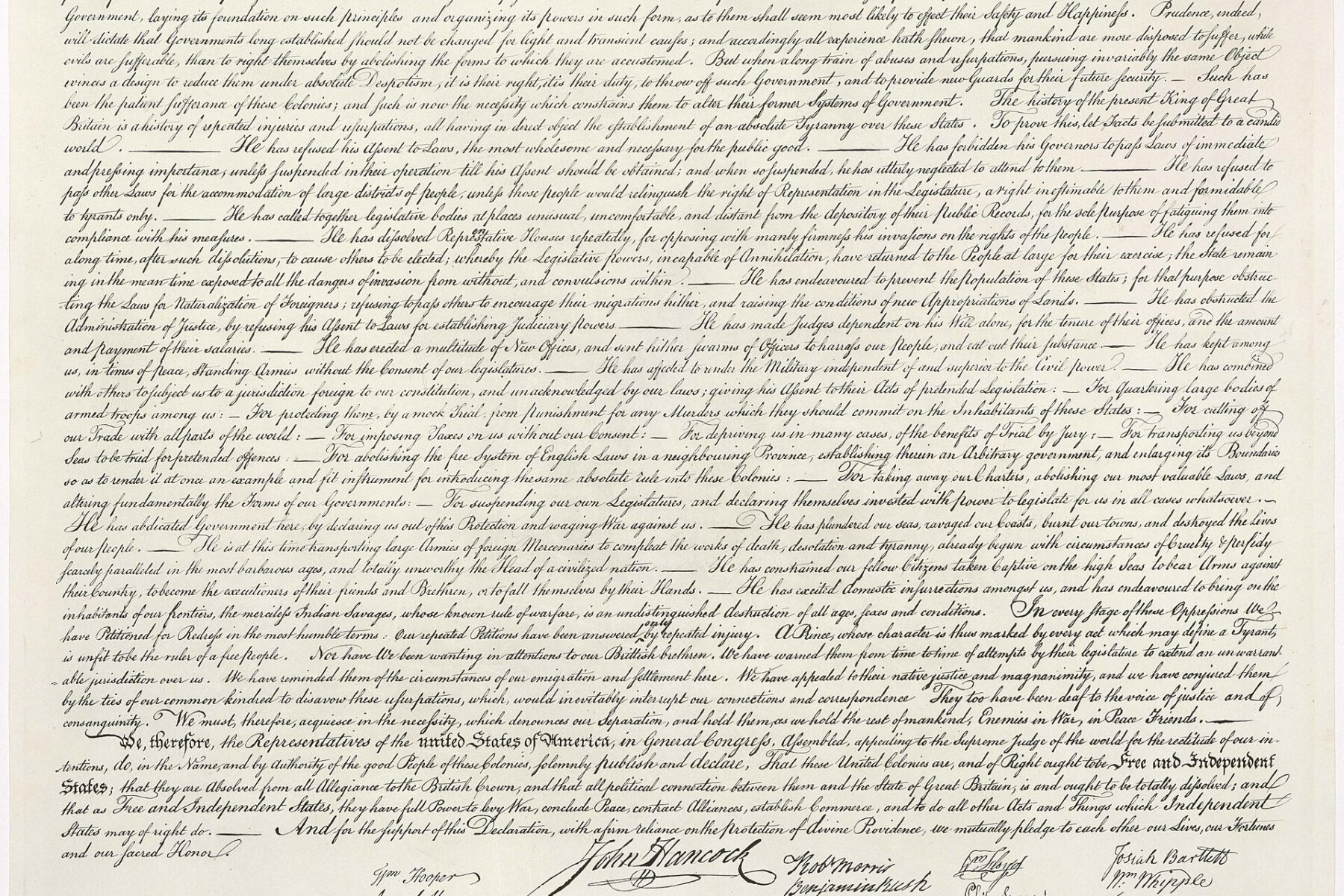
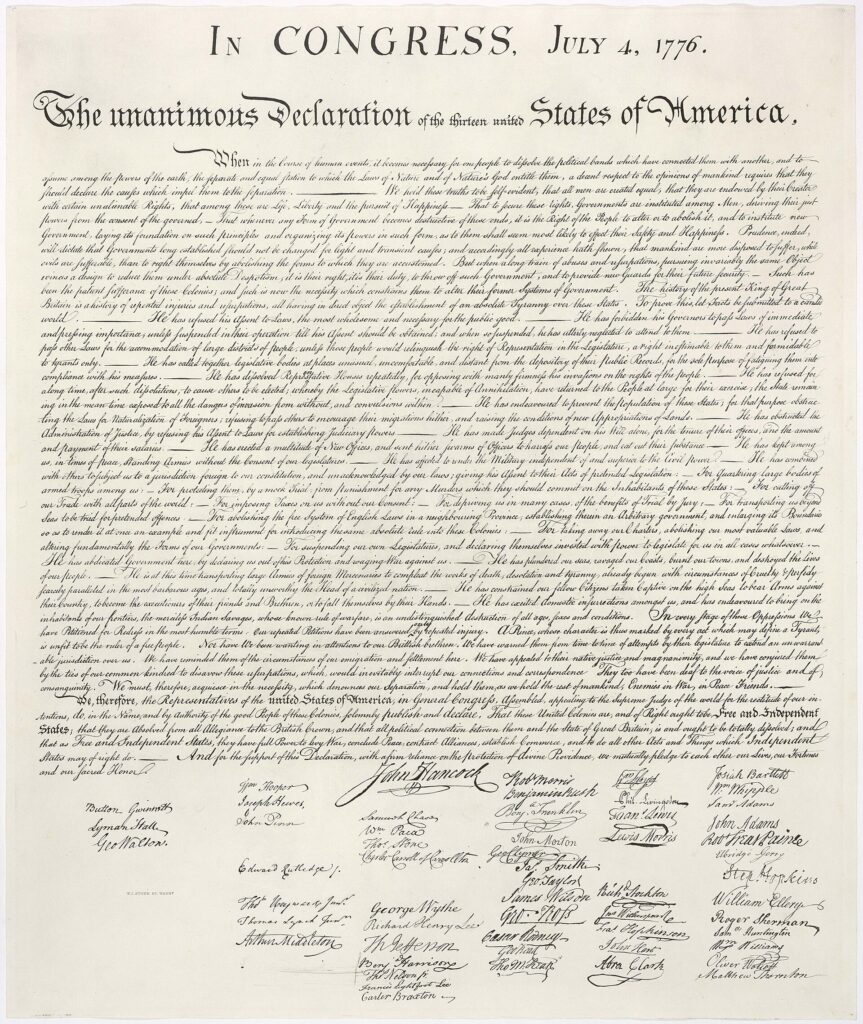
From head to foot, this piece holds and grows an ideal, with savvy word choice, design chops, decent calligraphy, and VIP signatures. The completion of it was followed by some good printing, press, and propagation too. It went places.
And as we know from history, this document was effective.
The structure is a world of self-reinforcing concepts and expansiveness all at once. It defines what key things are like what States are, and what they do. It also defines human rights. And it regularly cites nature as the ultimate authority too. In my world, that’s pretty telling.
My country was “born” by this thing. My country also came about after a loads of bloodshed, posturing, purloining of resources, forced labor, tossing tea, and meetings. But right now, I’m talking about this doc as a doc only. No value judgements. I live here.
Word choice, design, and psychological structure.
Title
The Declaration of Independence starts with a context of time and place: In Congress July 4, 1776.1
Then the title: The unanimous Declaration of the thirteen united States of America.
Aside: the phrase “Declaration of Independence” is nowhere in the document itself. The term was coined by the press. Yet one more reason a free 4th estate is foundational to our nation.
I can imagine as the founders discussed early drafts of this document – realizing that using the word unanimous would be self-reinforcing and bolster the emotional juice of their endeavor, starting in “the room where it happened.2”
Every time the word unanimous was read or said, the assertion would force members’ agreement or disagreement, either creating more unity, or smoking out of nay-sayers until consent was deeply reached.
And it is hard to argue with unanimity. The language + psychological impact of this word leaves no room for being separate from. The drafters of this doc seize word power by speaking for everyone. And, honestly, it’s a lovely feeling too: unified feels fine.
The founders could have titled the work, “The colonies’ grievances against the King of England,” which is pretty much what the bulk of what’s written. But they didn’t. They did call him a Prince though, just to stick it to George III as they worked some words into a separate nation.
Audience Matters
This document preaches to the choir, IE is aimed at the other colonists, not only the king, which is important. Every writer who knows their audience can usually meet it, and grow it. In this case, the declaration can be read by anyone and feel pointed AT them: the agenda is pure ideology.
Claiming unanimity, at a time when not everyone was literate or being counted, wasn’t “real” unanimity, but the language was effective in the worlds the founders walked in – a civilized world where words became more powerful than bullets in nation-making.
Yet, the piece is full of metaphoric ‘bullet points’ too. Jump down in the document, and read after “let the Facts be submitted to a candid world,” for a 1776-styled pile of grievances: Bam, Bam, Bam. How could anyone in their right mind allow for that kind of rule? Stirring up problems from across the ocean, disrespecting internal decisions. Sheesh.
The document says that nature can’t even allow them to stay under British rule. Pretty darn bold of them to speak for nature, but nature is another thing that is exceedingly hard to argue against. Or only to one’s own peril.
Declaration
The word Declaration is a “proclamation, formal public statement” from 1400’s earliest meaning3. I also can imagine some powered wig man looking dead-in-the-eye across the room to any colonists still wavering and saying, “I do declare your crops are wilting. Perhaps you should save your safe travels to horseback on your own farm.”
Here, declaration winds up the fundamental noun of this grand document on parchment. It’s the first “thing” we deal with. An announcement. Like for a party. Except those came years later with fireworks in the sky. In 1776, there was loads of writing to do and agreement to cement.
As a designer I see how the non-sentence case Capitalization is important, as is the the way the document lands on the page. You can look carefully at the Stone facsimile below to see what I’m talking about. Why would Happiness be capitalized, but not pursuit? The inconsistent standard begets understanding at another level too.
Some nouns are nascent, some formed like Forces.
Why we bothered to write this thing
The preamble starts with When in the Course of human events, it becomes necessary for one people to dissolve the political bands which have connected them with another, and to assume among the powers of the earth, the separate and equal station to which the Laws of Nature and of Nature’s God entitle them, a decent respect to the opinions of mankind requires that they should declare the causes which impel them to the separation.
This is their “why.” If they are to assume among powers of the earth ANYTHING, they feel they must be decent fellows and suitably explain themselves. We are talking educated men writing after all, not wielding swords and bullets and fisticuffs. So they say why they are going to hammer the king verbally before they get to it.
First Body Words: supporting strength.
The opening body line starts with “We hold these truths to be self-evident.”
Hold is a key concept here, which is passive. Holding in a physical sense requires strength and presence. It’s of a feminine principal. Holding truths is also a huge carry. Fortunately, there is specificity: only these truths… the ones that follow.
The document goes on to say the truths: That all men are created equal, that they are endowed by their Creator with certain unalienable Rights, that among these are Life, Liberty and the pursuit of Happiness.
I’m now going to do what Jefferson does throughout his writing, which is add in a new assertion to what’s understood about Big Ideas already: that the word men in this document actually means humans. It’s 2026 after all–our sesquicentennial–and this is settled business.
The adjective inalienable before rights is critical. This word again cites Nature for foundation. Inalienable means unable to be removed: something so intrinsic to your being that you don’t need to protect it from being stolen. It can’t be.
Definitionally rights cannot be taken, ever. So these rights don’t need to be asserted, nor do we need to fear their loss. So why bother to talk about them? Well…
As we’ve come to know from history, rights may require announcement or exercise from time to time for them to get recognized as being as unassailable as they are. Or we simply need to get stronger in our holding of truth and rights. Nature is on our side protecting rights, no matter what.
Think about a King vs. Gravity. Doesn’t matter how powerful or protected one is, Nature will always win.
But as for rights (the concept), they were rarely stated in plain words prior to this document. Really, people didn’t talk about rights much in history outside of democracy. They just knew what felt good or bad, or was fair or overreach. And the British did plenty of overreach.
Government as a “securing” force. Um, what kind of powers?
That to secure these rights, Governments are instituted among Men, deriving their just powers from the consent of the governed.
Adding just as modifier to powers here defines that correct and fair powers come from the consent of many. This implies powers exist that are not just– basically saying the king is not. And that good stuff comes about from collective institutions. That is, humans banded together kind of self-determine what’s fair in general. You know, Society Stuff like don’t steal or kill or be a jerk. Also don’t raise your voice when a powerful pen can kick butt better.
As I think about this clause, it points to why anyone would desire a government at all. And it says to secure rights. To me this statement implies we don’t need government, but that we create government because it helps us discern just powers, vs. rogue or unjust powers. And it implies that banding together is a good thing.
Fair enough.
The document goes on to say if any government does stuff that is unjust, it is the
… right of the People to alter or to abolish it, and to institute new Government
Then says where foundation is to be put down, besides the obvious North American soil:
laying its foundation on such principles and organizing its powers in such form, as to them shall seem most likely to effect their Safety and Happiness.
I think it’s important that Safety makes an appearance here for the first time, in Name Case. Our new government should help people feel Safe and have a shot at Happiness, which was not the case at that moment. The Founding Fathers may have well said: George, we don’t feel safe, and you’ve removed our ability to be happy.
Then, another Name Case principle speaks: Prudence
Prudence, indeed, will dictate that Governments long established should not be changed for light and transient causes
Governments are supposed to Secure rights and help governed feel Safe. And if they don’t, they need to change. This next part says, but don’t make changes capriciously. You really, really must have a really good reason, because the bad stuff has persisted for so long, oh yeah, and Nature.
Then the list of grievances follows soon thereafter. It’s a solid list.
We Tried to Work With You.
The founding fathers again, being reasonable (perhaps should be capitalized like Reasonable) say: And then Oppressions We have Petitioned for Redress in the most humble terms,4 and to paraphrase, you did even worse in response.
Seriously, Kin?
I’m running out of time to complete this essay today, so I’ll say the next part of this doc is the sad damnation of those who acted solely as British citizens, not fellow humans. The colonists cite that the Brits do not act with normal rules of civility. So they must, hold them, as we hold the rest of mankind, Enemies in War, in Peace Friends. That’s a huge split after they mention “common ancestor.” Basically its a F You.
Then the Declaration sums it up by stating the colonies are Free and Independent States; and Absolved from all Allegiance to the British Crown, with further details to follow about how an Independent state acts and what it can do.
Jefferson’s Study of States
What Thomas Jefferson does in this draft that is perhaps the most amazing to me, is describe the nature of a state, of what a separation is, what a right is, and where “justice” is derived. Also, he couches a huge political maneuver in simple language like Life and Safety, while being aspirational with Liberty and pursuit of Happiness.
His clear outline of what a state IS and where it’s powers come from is brilliant, and the document on the whole supports its own assertions like flying buttresses keep a church vault high. Necessary supports.
How many people had been angry about governmental powers had the skills to actually create a new one? And do so so eloquently with droppings of deep shade, minus the bloodshed?
We know folks need to be educated and privileged to have the time to parse words toward greater things. They also need time, friends, and those eager to discuss ideals. With that, one can craft concepts into words that move not only mountains, but move the kings out of our business. #NoKings
FOOTNOTES & SUB-SUBTEXT
A poorly formatted Webliography of trusted sources:
Etymology of “congress” is here. Etymonline.
Declaration of Independence Transcript here, National Archives.
Wikimedia Commons Image (un-refuted since upload) here.
