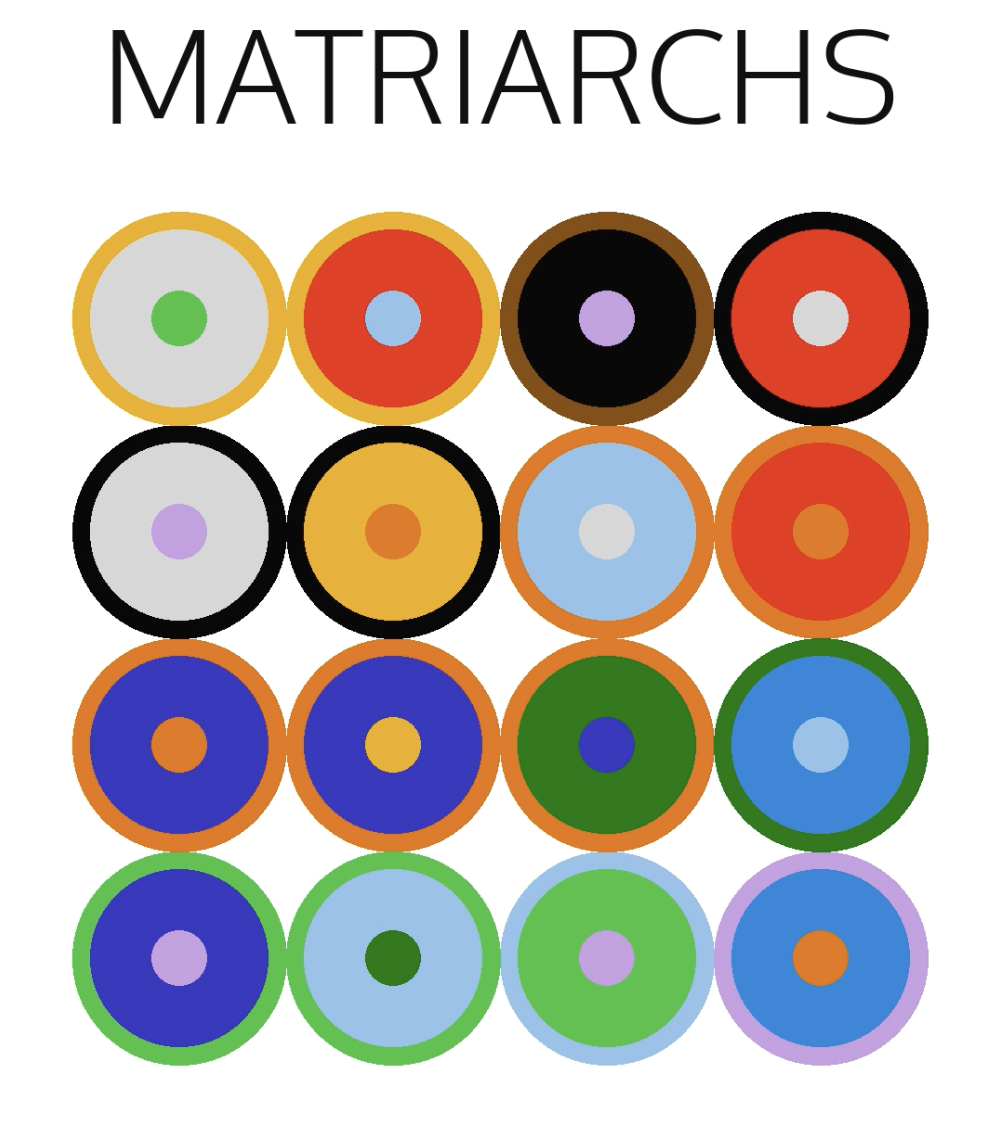
Includes notes on creativity, ai, and inventing new languages with symbols.
The Toland Colorscope system1 reflects an individual’s labor of love, and showcases people, color, astrology, metaphysics, history, geometry, relational dynamics, design, and symbolic language.
The system consists of 1728 unique color personality profiles (123) that reflect intuited color assignments mapped to astrological signs and their elemental meanings. Have a look at some iconic people represented with this system. 2 3
Origins of Toland’s Colorscope
In full disclosure, and with a request for quality follows and shares, I run the Instagram Account for Colorscope. There we seek a curious, smart, creative audience. Would you like to know your Colorscope? Find it free on color-scope.com.
About The Maker
Alix Toland, is an intensely creative person taught by gardens, art, observation, and copious reading. As a child, she was greatly shaped by conversations with her Ivy League father whose curiosity and enthusiasm were infectious. Toland followed an artist’s path over the sports-based competitive culture of her family. Despite a keen intellect, she had “no relationship with school,” and did not enjoy traditional education. On entering boarding school, she found a quiet room, and trained herself how to play and compose on piano.
Toland composes musical pieces quickly from alphabet-to-musical scale assignments. She can start with a word – translate it to a scale – and compose an entire near-symphonic piece. While discussing upcoming themes for Colorscope, she occasionally excuses herself to work something out on piano in the other room. What emanates from that space is rich, complicated, bold and coherent.
Toland imbibes a consistent diet of quality music, art, film, books and history. She also does not care to have her face and name all over her work, preferring for the system instead to stand on its own merits. Remaining steadfast in a tradition of great academics, philosophers and artists, she knows work of quality will find a proper audience, even in a realm overwhelmed by dancing personalities, AI slop-and-chop marketing, and POV videos.
Toland makes the language by which she creates and shares her visual understanding of the world. A form of meta-level4 creativity.
The Colorscope system is based on astrology. Toland could not have accomplished this body of work without Lois Rodden providing accurate birth times of interesting people throughout history.
In the early 2000’s Toland combined her interest in astrology with visual color theory of artists Albers, Klee and Kandinsky. Toland synthesized and built upon this color work in a new way, simplifying and assigning colors to the 12 astrological signs. She also diligently researched and wrote interpretations for each of the signs positions in the form (see below), and ultimately obtained a US patent for this color-centric personality profile.5
Colorscope is to be thought of as a system, says Toland, where form, color, meaning and research culminate in a visual stamp that promotes understanding as simply or deeply as the viewer wishes to see.
The visual bullseyes that results after entering one’s ascendant, sun and moon signs at birth, can be read as immediately as a symbol6, or reveal as much depth as one seeks by contemplation, viewing in relational groups, or by “working it7.”
Colorscope is designed to be so clear in form child can understand it immediately without knowledge of all the traditions and detailed information that underpin it.
And that’s part of how it began
Colorscope began with a box of crayons. Toland had a vision of a friend’s astrological chart represented as a Colorscope. She recognized the simplicity and immediacy of this system to help people understand things normally considered complex.
Toland found presenting this to children in her family helped them recognize their amazing potential and how they fit within their group. The system can be intuitively read and quickly relay similarities and differences that promote self understanding.
The Form Explained
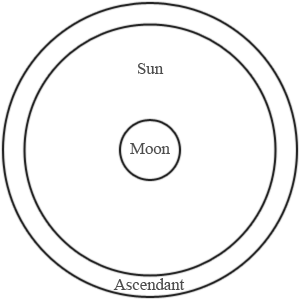
Each Colorscope is a color depiction of:
One’s astrological Ascendant – defined as how we meet the world, an outer ring encasing the form.
One’s Sun Sign– defined as personality.
One’s Moon sign – defined as one’s inner heart.
Each Colorscope portrays 3 key astrological components of a birth chart: Sun sign, moon sign and angle of ascendant (AKA rising sign). The form is filled with color based on those signs, their colors + person’s birth data.
The website describes the form in more detail, and provides a free tool to determine your own Colorscope.8
For those of you who don’t know astrology, two of the three components of change rapidly and are not the same for people born the same day, same year, or even the same place. Therefore to see yours accurately, birth time is required.
Moon signs change every ~2.5 days, which means someone born in the morning may have a different moon sign than someone born that same day in the afternoon. Moon signs can reveal emotional nature, and heart-based yearnings and gifts.
And, approximately every 2 hours ascendants change. So in any given day, all twelve signs are represented = the entire gamut of the zodiac. So over a hundred ‘scope’ variations are possible within any given month and up to 24 on a given day.
Ascendants9 are portrayed as the outermost concentric circle. The sign that’s rising can help us understand what others’ see. I like to think of Ascendants as a “style” or “method” and “persona” that depicts how a person shows up in the world. By looking at the form, you can see how the form physically represents this “outer-ness” in an encapsulating ring circling more intrinsic aspects of one’s nature.
Relativity of color and relationships
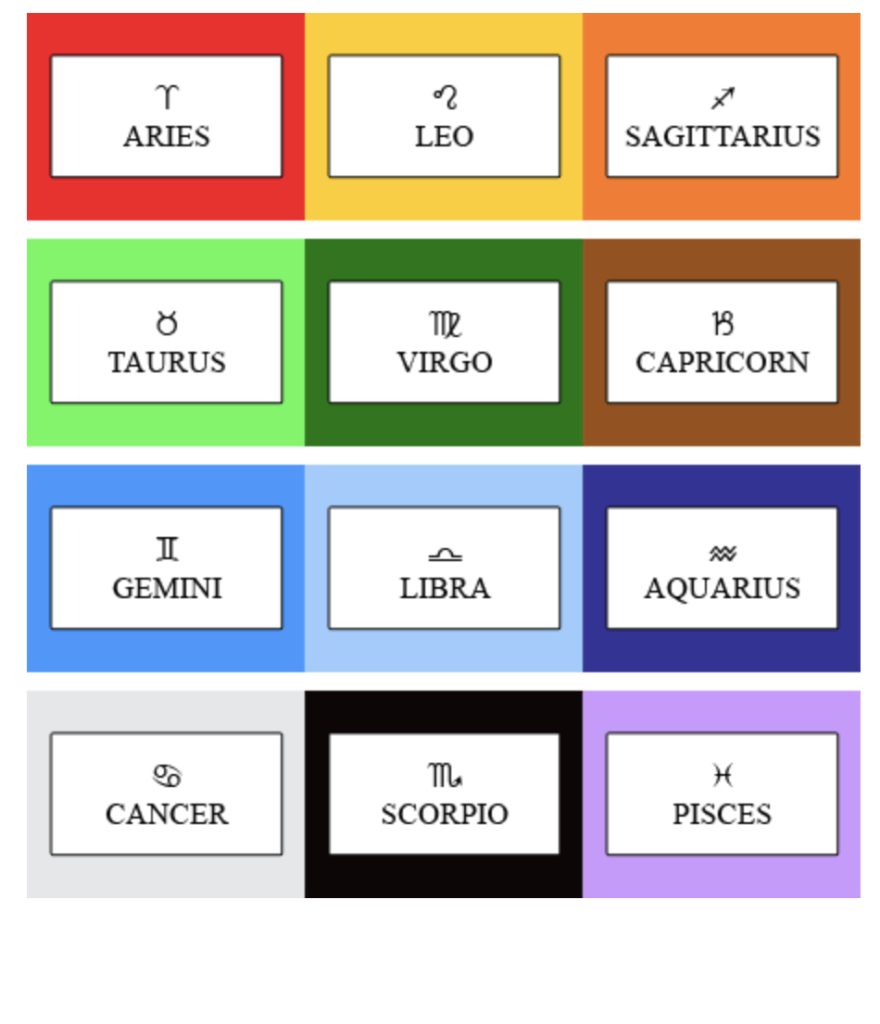
This color assignment reflects the signs natural relationship to the four elements; fire, earth, air, and water.
Toland writes, “both the astrological signs and colors have distinctive properties all their own and yet, like living things, they are relational in nature. Just as colors are sensitive to one another, so are the astrological signs. Both affect and alter one another with tremendous interaction.”
The abstract artist and teacher Josef Albers stated that, “One and the same color evokes innumerable readings.”
Seeing Double: interpretations
Each Colorscope can have up to 3 colors, which may or may show a classically understood color harmony. Additionally, having doubles of a color can also indicate relationships between aspects within oneself.
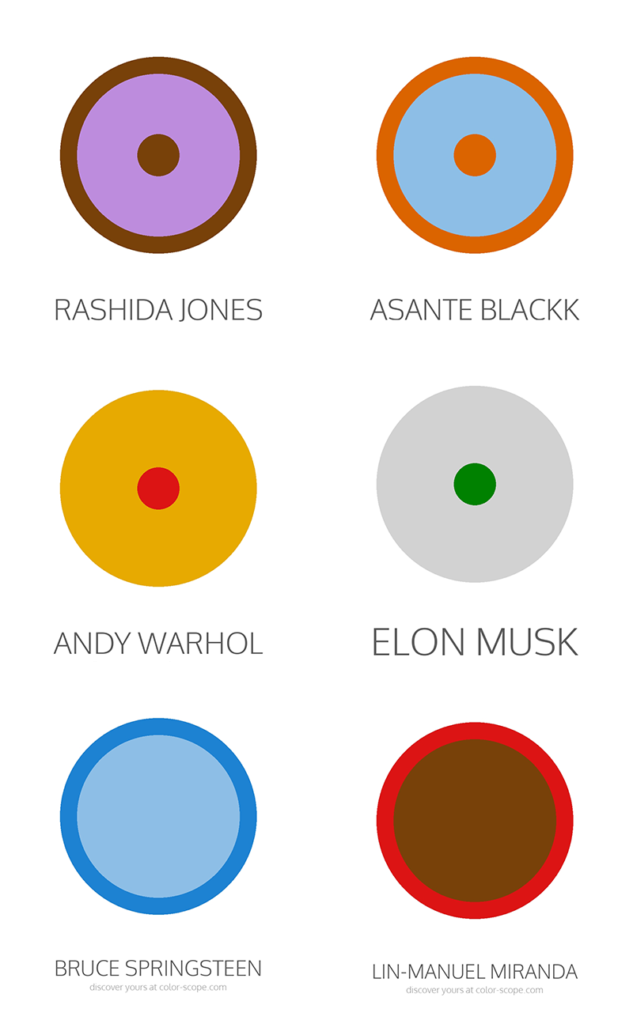
For instance, people with an ascendant and moon in the same color may appear to “wear their heart on their sleeve.”
When ascendant and the sun sign share the same colors, it can be interpreted as as “what you see is what you get.”
When the sun and moon are the same, it means the person has their personality and emotional fields unified.
The sun and moon fields enhance one another, and Toland considers this combination a particularly lucky mark.
The Colorscope system offers an entry point wherever you are. Would you to see your colors or produce a simple profile stamp. We encourage individuals to use this system and learn from it.
Would you like to see your role in an organization, with the depth and breadth of a Myers-Briggs, but visually? Yes, you can.
Group dynamics in quick minute
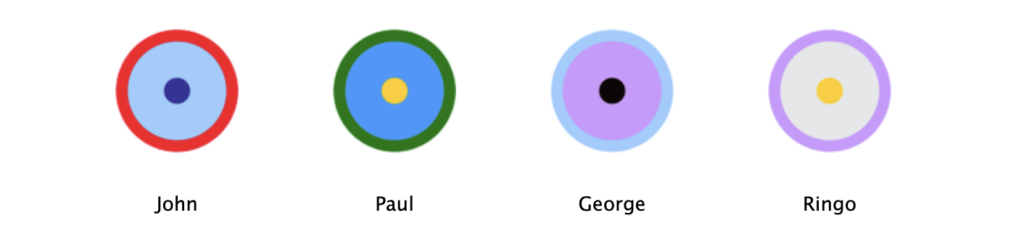
You can also view your relationships to others in an instant by viewing a group of Colorscopes, and intuit/interpret where natural creativity lies, where the leadership is, where the practical stuff manifests and so on. You can gain some insight from colors alone, and for more detailed understanding, look up the Colorscopes on the website. Look carefully at the scopes above. What do you see? [Beatles interpretation on the color-scope.com blog]
You may notice the dark, quiet emotional intensity of George, surrounded by balanced Libra exterior and mystical Pisces personality. Perhaps you can see the reflective fluidity surrounding the proud strong heart of Ringo – a steady bright beat (aligned with Paul’s).
Maybe you can see visually the complementary energy between John and Paul, who’s scopes show bolder colors with no overlap, but nonetheless strong “air” presence – the realm of expansive ideas. Perhaps you can see the practicality of Paul, with the only earth sign in the group (Virgo Ascendant) – diligent and detailed in practical matters, while John may boldly ram ahead into new experiences with Aries Rising. [more on the color-scope.com blog ]
Personal notes
What I appreciate about Toland’s Colorscope is it shows via a consistent, researched symbol set how people are different, with no judgements made on better or worse. Through this system, ideas around how we get along with one another can be directly perceived. Even with no astrological understanding, the colors can show us where there is ease, where there is not.10
The system offers an immediate view on how to understand someone very different from us.
The 1728 interpretations Toland includes on the website for each scope provide positive and negative aspects of each sign in each position. The website also includes pairs of famous people.
Did you know Bill Clinton and Monica Lewinsky share the same Colorscope? And how interesting that Steven King and Mary Shelly do: two masters of horror literature? How about Vincent Van Gogh and Ram Dass: seers?
No matter your take on nature vs nurture, the critical role of human choice, the reality of free will, or the accuracy of astrology, you’ll likely see some interesting patterns in color, and increase your visual perceptive capacity, while getting to know a bit more about human nature using this new tool for self-discovery, understanding, and connection.
Personal Explainer: why am I using AI on this project
I’ve said I wouldn’t use AI for creative work, or if I did I would say so.
Over a decade ago, I was given an opportunity to build the initial color-scope.com website. Once the system and project was described and shown to me in sketches, I could see how the site could look, how the scopes could be composed live on the website and I could envision the public interacting with the site, watching each aspect of form come into view one at a time11. I loved the idea of this concept and research becoming available for the public. I could imagine the interesting experiences people would have exploring the rich historical context and self-realization tools built into it.
And, I wanted to help.
But I didn’t have the coding skills needed to do the job.
I also didn’t want to double-down on learning the language of code. After all, there were so many languages: php, java, html, python, C+ and others. All binary, all unsatisfying (to me). Being hyper-lingual in code was not my calling. Being a visually creative person helping creative people do good things on the web was.
At the time, I saw the web as a vast (and expanding) medium, and I was weaving little bits of functional, appealing, interactive beauty where I could for the people who asked.
I’ve also always considered myself a bit more of a code hacker than code writer. I started making things happen by hacking at WordPress php code (version 1.4); and did fun stuff with tables in raw html raw code generated via terribly ugly .txt files. Later I moved to Microsoft FrontPage (if you know, you know, and it’s not good), Adobe GoLive (miss you), and later Dreamweaver (solid but complicated). I was able to achieve results, help people explain and sell loads of stuff, attract great guests, represent themselves artfully and authentically, without learning how to write php or scripting codes from scratch.
I still don’t. My coding has always been a bit of a mess.
Fortunately, another coder with more time and patience got the job. He did it well, and I was happy and helpful to him for the sake of the idea getting wings on the web.
See, even if I couldn’t make my vision a reality properly, I still wanted to see it go live. And it did. The website is currently getting upgraded by same designer too – Todd is on it! (thanks Todd!)
Fast forward to today, and it seems it is time to bring this system to a larger audience. Alix Toland and I are working on this mindfully on a platform that still seems to have some integrity, is well suited to visual content, and affords sharing and feedback: Instagram.
So, I trained Claude on this project to serve as an assistant, checking color assignments, pulling from database, producing graphics and video reels in record time, and supporting me to build bits of cool html code like above.
So, I am breaking my own rules, but for the sake of serving a greater mission and without sacrificing the vision. This is perhaps the best of what Claude can do when properly trained, and also, I could write another post about the particularly odd hallucinations too.
Some of these yield “happy accidents,” some are a bit unsettling12 when you realize the logic of how LLMs are trained.
There is no wrap up sentence to be written here. The project is unfolding in real (and reel!) time on the web. Thank you for reading, following the story and viewing my work and Alix’s work as well.
Finally, if you are interested in some creative/metaphysical underpinnings and long-game long-form, here is another piece about Colorscope from June 2024.
FOOTNOTES | SUBTEXT
- Alix Toland has indicated to me she’d love to see people sharing their colorscopes with one another, and to play with the system to see patterns with loved ones. Colorscopes are uniquely suited to profile images. While the system is patented and trademarked, the individual, non-commercial use of one’s Colorscope is encouraged. I know when I dress in my colors, I feel fabulous. ↩︎
- To be transparent: I used AI2 coding assistance (via Claude/ Anthropic) to build that bit of interactive code: it is beautiful and functional, and helps to share Toland’s color language in a beautiful, moving, interactive embed.
This code will ultimately land in some form on the home page of her website as the color-scope.com, a website currently (as of May 23, 2026) being redesigned by the talented Todd Thille.
This kind of coding may be one of the finer things AI can do as a tool: support a creative person’s ideas, codify an aesthetic, and help people like me share creative work to a broader audience on the web (or as I like to think of it: using the world wide web as a medium). ↩︎ - Funny enough the “layering” of transparent scopes and loading time lag sometimes reveals an incorrect click through to explanation page. This makes it nearly a game to click correctly! IE user-accuity + layering + load timing = correct end destination. ↩︎
- Defining this term ‘meta-level creativity’ here as: creating a language by which you communicate. This is common in the realm of artists, musicians, writers and readers. More in glossary. ↩︎
- The patent is in place to protect from non-negotiated commercial uses, not to stop individuals from personally enjoying the system and sharing their scopes amongst themselves. ↩︎
- I personally love this aspect, as I explore symbols in my own work, very differently though. Follow my art page. ↩︎
- There is a section on her website about how to Work with Colorscope. ↩︎
- Privacy aside about website: no personally identifying data is collected.
Also, note the interpretations on the website show positive and negative attributes for each quality, and also include difficult historical characters like Charles Manson and Ted Bundy. Although someone could share the same scope as one of these people, they likely are shaped by values, environment and cultivation of kinder, creative callings, so scope ≠ fate. ↩︎ - For those of you intrigued by the science of astrology, the ascendant in determined by how the earth is spinning on its axis. Whatever constellation is rising on the horizon at the moment of birth, is a persons ascendant. ↩︎
- Please see these intriguing visual depictions of who shares a scope: Stephen King and Mary Shelly; the makeup of The Beatles; and the color relationship between an early “power couple” Paul Newman and Joanne Woodward. ↩︎
- We show some of this ‘coming into form’ visual reveal of colorscopes using video on Instagram. It’s well suited to this kind of visualization. ↩︎
- For my own personal well being, I feel I need to limit my time on this tool to no more than 2 hours a day, no matter how much it helps me produce. My guess is others perhaps should consider setting a limit too. ↩︎