
On “taking time for oneself,” rest, idiomatic expressions, etymology, and art from this week.
I occasionally steal time to do things like watch movies, walk in nature, write here, look up random words, daydream, and drink coffee. And, I usually feel like I’m doing something illegal while I’m at it.
Perhaps this is because of the language? You know “taking,” “stealing” and all. Taking has kind of a bad rap, especially for nice girls who like to serve and receive, but you can read more about that in my waitress essays.
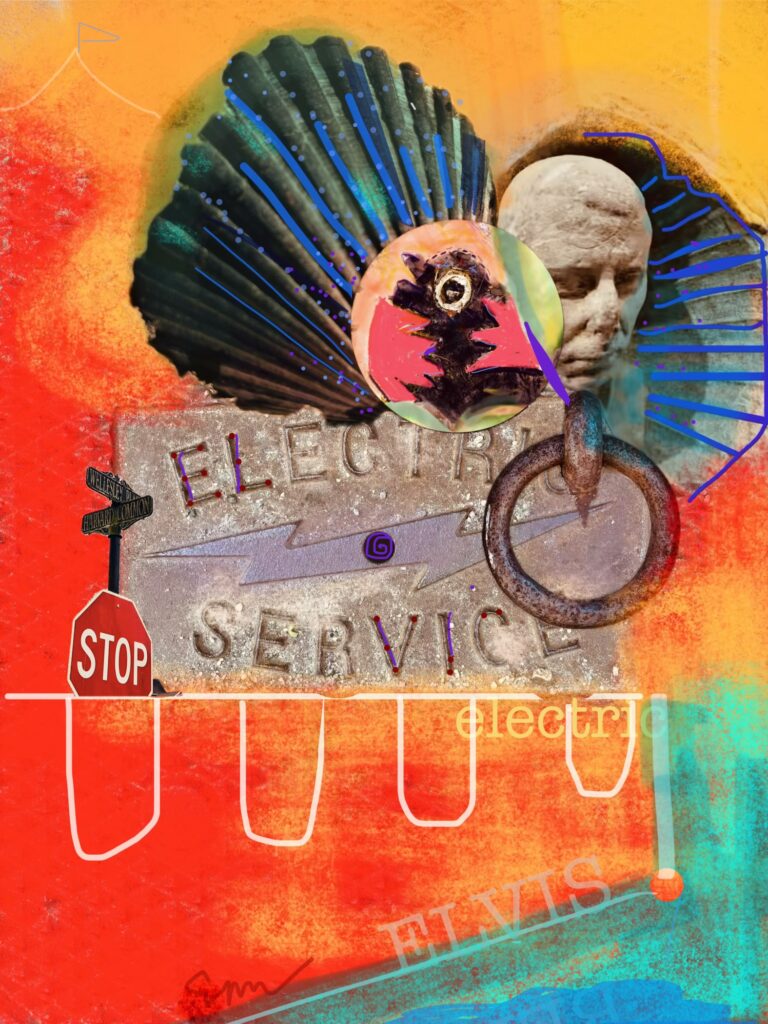
Bear, Man, Electricity
Collage art on iPhone, June 7, 2026
The Oxford English Dictionary calls take “one of the elemental words of the language,1” with deep roots dating back to a 1076 account of Danish raiders. Raiders perhaps being the key element with an implied judgement call of “bad” and “ill gotten booty.”
Yet take’s history as a word seems to have originated prior to that in spoken language meaning “to touch,” or “to grasp,” with similar sounds from multiple parts of the world. Touching and grasping are not inherently negative. So with that neutrality established, let’s leap ahead to the abstractions around the term take.
Abstracted Takes
The origin of “taking time” feels particularly poetic, no wonder I love it. In 1600 Shakespeare ignited this sense of the meaning in Midsummer Night’s Dream with the line, Take time to pawse. I can imagine this later getting shortened to be understood as “rest and reflection” by the two words alone. Shorthand of Shakespeare.
The only prior written use of “taking time” was 1567 legal argument in which seems one person is insulting another for not being prepared.
So Shakespeare takes the win for kindness, fun, and comfort.
“Taking” in terms of colorful abstractions became more spicy around the advent of the Industrial Age,2 with expressions like take the rap, take it easy, and take five came into use starting in the late 1800s through the 1920s.
These three expressions feel a touch like directives, with the latter two sounding like kindnesses granted by someone who holds more authority. The implied authority alone is interesting. Who is telling who to chill?
I am going to quickly skip over take as it means shooting with a camera, and take 101 in movie-making. Not because this sense of take doesn’t deserve attention, but because I love photography and film too much to keep it concise.
Even with this little bit of history of the take, I’m still struck with the conundrum around “taking time for ourselves,” as much as we may like to.
Blown Filters
A continuation study of morning surprises, shapes, causes (like the wind), electricity, and color. Markup on photo. June 2026

Partly because taking is a term built with an understanding of touching, and time belongs to no one, nor is physical. Time itself is a somewhat nebulous construct, not a thing. And we can’t touch nebulous constructs, as far as I can tell.
Idiomatic Expressions as Cultural Tells
Idiomatic expressions like taking time often hold paradoxes within them. From the history of the term itself and how it’s morphed into a variety of uses, we can understand a touch about a person’s consciousness and how they perceive the world.
Also, since we don’t all speak the King’s English, and we live in a multicultural world full of rich metaphor, code-switching, and poetry, seeking the common roots in language can help us hear and feel what’s being said directly, while learning more about our differences too, and poetic and intriguing turns of phrase.
Let’s face it, idiomatic expressions are loaded with information. And I’ll try not to take offense at the word idiomatic.3
A Rooted Take
The root of the word “take” comes from Middle English taken, late Old English tacan “to grip, seize by force, lay hold of,” from a Scandinavian source (such as Old Norse taka “take, grasp, lay hold.4” You can almost hear the sharp Ta! sound at the top of the word expressing something like WTF!, old style.
The question is, who walks away with the stuff, and who first said the word, the taker, or the one taken from…
My imagination goes back to a less civilized time, perhaps when barbarian-esque characters just grabbed whatever they wanted– firm grips greedy over resource acquisition. When desired resources were things like water, food, clothing, gold even, taking is easy to visualize.
But we know that humans only survive when we work together, when we share resources, care of elders, children, the sick and infirm, and also share nuanced, full-bodied language and understanding too.
I hope you take away from this ramble, a bit of awareness about the origins of language and the depth a given word can portray. Finding a story in a widely-used term, well, that can be done by taking a word apart, and finding it’s likely spoken origin, while watching the flow of meaning as it moves throughout time and space, and how it used in the hands of creatives…
and what takes hold.
And when it comes to taking time “out”? That feels like a little kid being shoved in a corner for bad behavior. Taking time for oneself, well, that just seems like a grownup thing to do.
Webibliography5 & Footnotes
In case you were wondering, this is another Term of Endearment post.
Oxford English Dictionary Online
Etymonline
English StackExchange.com
- Source: Etymology Online. ↩︎
- https://www.etymonline.com/word/take ↩︎
- Have you listened carefully to Idiot Wind by Bob Dylan? Encouraged.
↩︎ - Source: Etymology Online. ↩︎
- This is material originates on the web from reputable and interesting human sources, not necessarily books. But I see these sources as high quality and/or interesting and/or thorough. ↩︎